
Janmashtami Rituals
Janmashtami Rituals
On Janamashtmi, devotees keep daylong fasts and keep themselves awake while chanting bhajans , until midnight follows.
Midnight is the moment when Lord Krishna was born. The prayer ceremony is a simple affair.
The priests chant holy mantras and bathe the idol of Lord Krishna placed on a swing with Panchamrit made of milk, ghee (clarified butter), curd, honey and sugar from a conch shell and Ganga-jal (water from the holy Ganges River).
Common Janmashtami customs followed across the world includes fasting and chanting of mantras, but, Mathura, Vrindavan, Dwarka and Mumbai follow some additional traditions and rituals as a part of Janmashtami celebrations. Some of them are:
- Fasting:
Most devotees fast for the entire day on Janmashtami as an integral part of celebration. There are two common and popular types of fast undertaken by different devotees, namely:
1. “Phalhaar Vrat”:
This kind of fast allows the intake of juices, milk products, tea etc without the intake of cereals. One time food intake comprising of food made with vegetables and “Senda Namak” is allowed.
2. “Nirjal Vrat”:
As according to many traditions fasting is considered an integral part and from of showing devotion to Lord, some devotees undertake a fast without the intake of even water.
- Fasting Foods: Lord Krishna was supposed to be fond of Milk, curd, butter and other forms of milk products , thus, having an intake of milk products on the day of Janmashtmi is very auspicious.
- Chanting:
Krishna’s birth (Janam) is associated with extreme joy, festivity and jubilation. As it was a mid-night birth and a very auspicious composition of stars according to Hindu mythology, chanting of Mantras, singing Bhajans, offering Aarti is popularly adopted.
A common practice of celebration on Janmashtami involves the chanting of 108 names of krishna along with, showering of flowers on the idol of Krishna.
“Hare Krishna Hare Krishna, Krishna Krishna Hare Hare.
Hare Rama, Hare Rama, Rama Rama Hare Hare”
Is a very popular chanting mantra of lord Krishna.
- Ceremony of dahi-handi :
Janmashtami Rituals
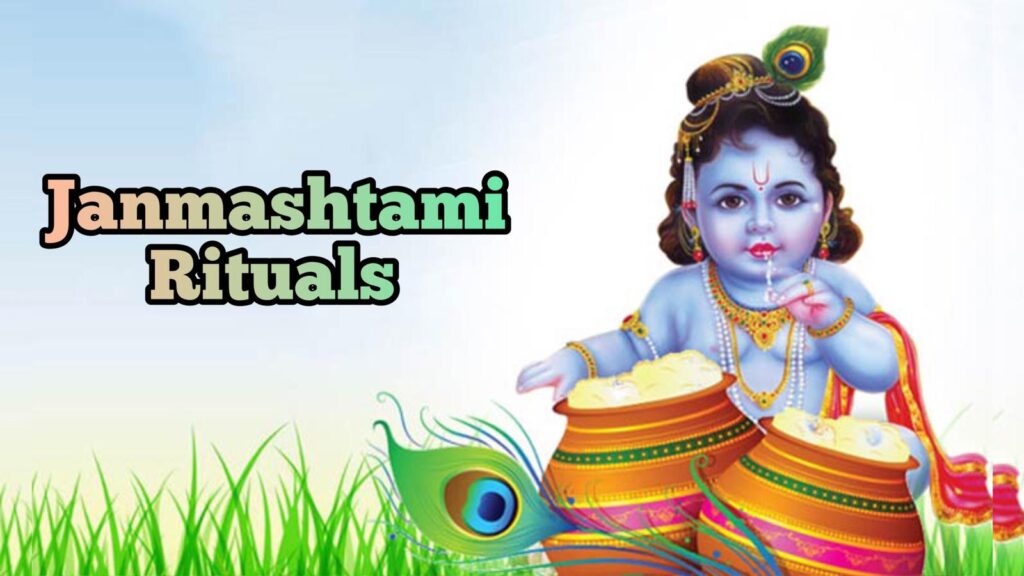
Popularly followed in the cities of Mathura, Dwarka,Vrindavan and Mumbai, the ritual of Dahi-handi is an enactment of Lord Krishna trying to grab butter from the pot (handi), by young boys. As Krishna was fond of butter (Maakhan), this tradition brings lot of fun, frolic and emotions with it.
1. How is it performed?
In an earthen pot, milk is put with some ghee, and, dry fruits, which is then suspended on a height of some 20 feet.
The boys form the shape of a pyramid, and try to break the pot in an organized manner. It is customary that people standing around, throw loads on water on these boys to stop them grab the pot.
2. Religious significance:
The act of Dahi-handi is believed to throw away all negativities and bad-omens.
- Rasleela:
Gopis (Sanskrit word meaning a group of cow-hoarding girls), were in intense and divine love with Krishna. Rasleela was traditionally a sport, fun activity that Krishna performed with Gopis. As Krishna wanted to give every Gopi equal importance, he always stood in the middle of a circle surrounded by Gopis.
1. In Vrindavan:
Vrindavan till date, is drowned in Krishna bhakti. Throughout the festival of Janmashtami, young Brahmin boys gather in groups at common places and indulge in the act of Dahi-handi.The language used is “Brij Bhasha”.
2. Types of Rasleela:
Janamleela: throws light on the birth of lord Krishna.
Shankarleela
Putanaleela: Killing of demons by krishna
Nagleela
- Janmashtmi Prasad
The most famous Prasad (divine gift from god/guru), prepared and offered at temples during janmashtmi is “Panchamrit”.
Panchamrit:
Panch means five and amrit means nectar, it is a an important form of “prasad” served at many festivals.It is a mixture of
* milk
* honey/sugar
* ghee/oil
* curd/yoghurt
* tulsi leaves.
Along with panchamrit , the fruits and sweets offered to lord during Prayer can also be offered as “Prasad” .
Janmashtami Puja (Janmashtami Rituals)
Janmashtami is the celebration of the birth of Shri Krishna. Shri Krishna was born on the 8th day of Krishna Paksh in the month of Bhadon in Rohini nakshatra at midnight.
He was born in a prison in Mathura to Vaasudev and Mata Devaki. Shri Krishna was raised by Mata Yashoda and Nand Baba in Vrindavan. His older brother was Balram, an avtaar of Sheshnag.
Although the timing of Puja varies in Janmashtami, as the entire day is believed to be very auspicious, most people prefer to conduct Puja at mid-night. The general routine for the entire day goes like this:
preparation
A small cradle decorated with flowers and a small potda (handkerchief is kept in the cradle)
New clothes for God’s idols
Panchamrit made out of unboiled milk, curds, ghee, honey and powdered sugar
Flowers and flower garlands, chandan, ittar
Puja Process:
* Early in the morning, devotees give a bath to Lord Krishna, which is also termed as “abhishek”. The bathing ingredients comprise of the Gangajal, ghee, water, honey and curd.
* Once Bal-Gopal (Shri Krishna) is given bath, devotees embellish and beautify the idol of Krishna with newly purchased jewellary, accessories and clothes. Many devotees spend days before the Janmashtami to purchase these clothes and ornaments for Krishna.
* The idol of Krishna is then made to swing as a part of tradition.
* Bhog (an offering to lord), comprising of fruits, kheer, pedha etc… is offered to Lord.
* Along with all the above steps Krishna Aarti, mantras, bhajans are sung melodiously that fills the environment with positive vibrations.
Click Here For various PUJA OF LORD KRISHNA
Krishna Aarti
Arti is one of the most important parts of any pooja process on any festival. Krishna arti is as follows. Is is considered to be very auspicious to play some kinds of musical instrument along with singing the arti.
Aaratii Yugala Kishora Kii Kiijai
Tana Mana Dhana Sab Arpana Kiijai
Ravi Shashi Koti Vadana Kii Shobhaa
Taahi Nirakha Meraa Mana Lobhaa
Gaura Shyaama Mukha Nikhrata Riijhai
Prabhu Ko Ruupa Nayana Bhara Pijai
Kanchanna Thaala Kapuura Kii Baatii
Hari Aaye Nirmala Bahii Chaatii
Phuulana Kii Seja Phuulana Kii Maalaa
Ratna Sinhaasana Baithe Nandalaalaa
Mora Mukuta Kara Muralii Sohai
Natavara Vesha Dekha Mana Mohai
Anga Niila Piita Pata Saarii
Kunja Bihaarii Giravaradhaarii
Shri Purushottama Girivara Dhaarii
Aaratii Karata Sakala Nar Naarii
Nanda Nandana Vrushahaanu Kishorii
Paramaananda Svaamii Avichala Jodii
Legends of Janmashtami (Janmashtami Rituals)
“Yada Yada Hi Dharmasya
Glanirva Bhavathi Bharatha
Abhyuthanam Adharmasya
Tadatmanam Srijami Aham”
A shloka taken from Bhagvat Gita where Shri Krishna while addressing Arjuna says “Whenever there is decay of righteousness, O! Bharata and a rise of unrighteousness, then I will manifest myself”. And so he did.
As mentioned in this shloka and also according to the legends, the birth of Lord Krishna took place under extraordinary circumstances. He was an incarnation of Lord Vishnu who comes to the world to get rid of all evil demons.
Mathura under Kansa
During that time Mathura was under the vicious rule of Kansa, who declared himself king after imprisoning his father Ugrasen. Lord Vishnu decided to save the earth by taking birth in the human form. A divine prophecy proclaimed that the eighth son of Vasudev and Devki would kill Kansa. Hearing this Kansa, put his brother-in-law and sister in prison after getting the assurance that Vasudev will hand over his children to Kansa. All Devki’s children were eventually killed. However, the seventh child, Balram was saved miraculously by divine intervention when he was transferred from Devki s womb to that of Vasudev’s other wife Rohini.
Birth of Lord Krishna
Lord Krishna was born at midnight stroke on a dark, rainy night to Devaki and Vasudev who had been imprisoned by Devaki s brother Kansa. The guards had fallen into deep slumber and were unable to inform their master about the newborn child.
Krishna handed over to Yashoda
A heavenly voice commanded Vasudev to take the baby to Gokul and exchange with the newborn baby of Nanda and Yashoda. The shackles and the prison gates opened miraculously and Vasudev carried the child in a small basket, through the waters of Yamuna. As it was a dark stormy night, the waters of
Yamuna were raging but parted to let the carrier of the divine Krishna pass. A huge snake known as Adisesha with 2000 hoods, glided behind them, its hoods formed a protective canopy over the child.
Kansa Trying to Kill Yashoda s Child
When Vasudev returned back with Nanda s child the shackles fastened and the doors closed and the guards awakened. Kansa came and picked up the child to hurl it to the wall and kill him but somehow the baby slipped from his grasp and took the form of a Goddess laughing at Kansa, she vanished after telling him that the one who would kill him had already taken birth and was elsewhere. This Goddess was Yogmaya.
Young and Mischievous Krishna
As a little boy, Krishna was the heartbeat of Gokul, a mischievous prankster who was favourite amongst the gopikas. He used to steal curd and butter from the houses of gopikas. Even though he was a child, he performed several miracles. His exploits are now the immortal legends of Braj. He killed a number of asuras (devils), vanquished the Kali Nag and later he killed Kansa as it had been foretold.